Discovery Review and Case Build
The Answer Is Rarely Hidden. It Is Buried.
Discovery does not arrive as a case. It arrives as police reports, recorded interviews, photographs of phone screens, financial disclosures, prior court files, and a deadline. Somewhere in it is the detail that matters: the date that moved between two tellings, the conversation that ends before the messages do, the corrections sheet at the back of a three-hundred-page filing.
The difficulty is not finding the right document. It is reading every document, because the one that matters looks like all the others until someone reads it.
Atlantis reads every page, and cites what it finds to the page it came from.
What You Receive
For a production of up to 150 files and 3,000 pages, the core engagement delivers:
- Every page read. That includes scanned exhibits and image-only pages that ordinary text search passes over.
- Originals preserved and fingerprinted. Each file is digitally fingerprinted on receipt and never altered, so the file you work from is provably the file you received.
- An organized, indexed working file, with duplicates identified and near-duplicates compared page by page.
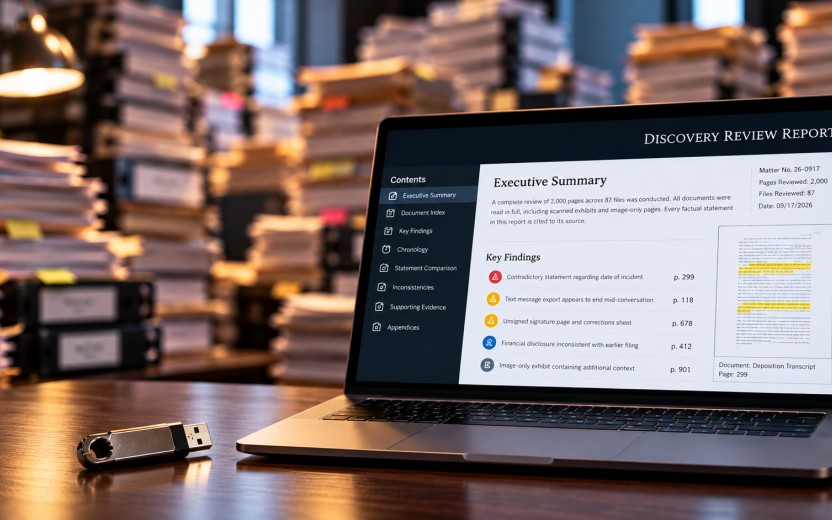
- A summary of every document, with each fact cited to the page it came from.
The core engagement is a flat $1,500. Send it by noon, and it is back by the end of the next business day.
When the Matter Needs More
The file is the foundation. Many matters need what is built on it:
- A findings assessment. Every factual finding is rated from weak to strong on a stated scale, with the supporting and contrary sources cited for each.
- Statement comparisons. Every account a witness has given, laid side by side: date, ages, acts described, and what changed between tellings.
- A Report of Investigation. A neutral analysis of the evidence as it sits, with a prioritized list of what is missing and how to obtain it. Items that require a subpoena or court order are identified up front.
Relevance is measured against the governing standard. In criminal matters, that means the elements and instructions in the California Criminal Jury Instructions (CALCRIM). The analysis is quoted at a flat fee before work begins, as are productions larger than 3,000 pages.
We build the file. You make the call.
How the Work Is Done
Custody first. Productions are received through a dedicated, access-controlled intake. Every file is fingerprinted before anything else is done, and the originals are held unaltered for the life of the engagement.
A complete read. Every page is read and every factual statement is recorded with its document and page number, or its transcript page and line. Recordings are transcribed and indexed, and marked as machine transcripts until verified against the audio.
Independent verification. A separate verification pass re-checks the extracted facts against the original page images. The verification is itself tested. Deliberately seeded errors confirm that it catches what it is supposed to catch. Errors found are corrected before any analysis is written.
Signed. Every deliverable is reviewed and signed by a California-licensed investigator.
Atlantis uses proprietary investigative systems to do in hours what a manual review would take days to complete. Everybody is talking about AI. This is more than AI: it is checked, it is cited, and a licensed investigator puts his name on it.
Confidentiality and Handling
Discovery is often the most sensitive material a firm holds. Atlantis handles it accordingly. Each matter is held in its own restricted workspace, shared with named individuals only. Backups of client material are encrypted. At the close of an engagement, client material is destroyed across the systems we control, and a certificate of destruction records exactly what was destroyed, what was retained and why, and anything outside our control.
Some of our analysis uses commercial AI services that do not train on client data. We will describe exactly how a production is processed before you send it.
Who Engages This Service
Criminal defense counsel, including court-appointed and conflict counsel, receiving discovery that has to be understood before the next appearance.
Family law attorneys whose cases have produced a record that now matters somewhere else: declarations, depositions, evaluations.
Civil litigators facing a production too large to read before the decisions it should inform.
Employers and their counsel assembling the record behind a workplace investigation.
For matters that require field work beyond the documents (witness location, interviews, records retrieval), see Litigation Support and Due Diligence and Pre-Litigation Analysis.
Send the Production
Atlantis accepts discovery review engagements under a signed retention agreement. If a production is sitting on your desk, contact us for a confidential consultation and secure transfer instructions.