The Record is Now Read in Minutes
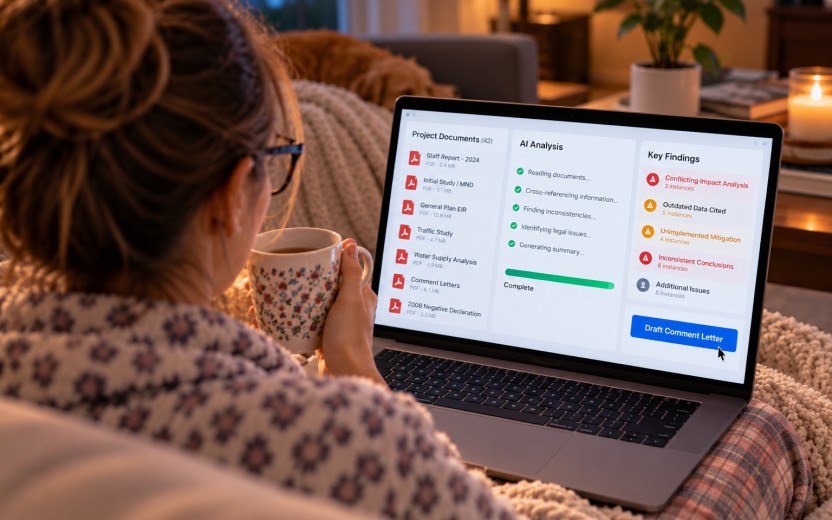
A neighbor with a laptop can now read a project's entire public record faster than the applicant's team can find it. Twenty years of staff reports, prior negative declarations, council minutes, traffic studies and comment letters go into an AI tool in an afternoon. A few minutes later, that neighbor has a list of every inconsistency, every stale study and every promise the city made in 2009 and never kept.
Then the same tool drafts the comment letter. It cites the page, quotes the prior finding, and frames the issue the way a petitioner would need it framed later. What used to take a land-use firm weeks and a five-figure budget now costs a motivated opponent a subscription and a weekend.
For developers, cities and the lawyers who defend them, the math has changed. The question is no longer whether opponents will find the weak spot in the record. It is whether you found it first.
What the Opponent's AI Actually Does
None of this is magic. It is the same fact finding a good investigator does, run at a speed and scale that used to be out of reach. It works in four passes.
- The pull. City document portals, CEQAnet, agenda archives and public records requests put the project's history in one folder. That includes the prior specific plan, the 2008 negative declaration on the same parcel, the general plan EIR it tiers from, and every comment letter on all of them.
- The cross-read. The AI reads every page against every other page. It catches the water supply analysis that cites a 2010 urban water management plan, the traffic study that counts a road that was never built, and the mitigation measure promised in 2012 that no one ever monitored.
- The contradiction list. It flags where the document disagrees with itself. A typical find: one section calls the loss of farmland "significant and unavoidable," and the summary table calls it "less than significant." Opponents used to stumble on these. Now they get all of them, sorted, with page cites.
- The draft. It writes the comment letter, organized by resource area, with the record citations a petitioner will need. With the right prompt it also lays out the elements of a challenge, issue by issue.
The part that should worry the project side is that the output is often accurate. Our own spot-checks of AI-assisted opposition letters have found citations that hold up. You cannot count on the other side's tool being sloppy.
Why It Bites Hardest in California
CEQA was already built to reward the side with the better command of the record. AI hands that command to anyone. Four features of the statute make the shift matter more here than almost anywhere else.
- The fair argument standard is a low bar. For a negative declaration or MND, a petitioner does not have to prove an impact. An EIR is required whenever it can be fairly argued, on substantial evidence, that the project may have a significant effect, even if the agency has contrary evidence. No Oil, Inc. v. City of Los Angeles (1974) 13 Cal.3d 68, 75; Pocket Protectors v. City of Sacramento (2004) 124 Cal.App.4th 903, 931; CEQA Guidelines § 15064(f)(1). An AI that finds the project's own documents disagreeing with each other is, in effect, assembling that evidence.
- Exhaustion now cuts the other way. Public Resources Code § 21177 limits a lawsuit to issues someone raised before the close of the hearing. That rule used to protect projects, because most commenters raised a handful of general concerns. An AI-drafted letter raises every issue, specifically, with page cites, and preserves all of them for any petitioner who comes later.
- The record is broader than the file. Under § 21167.6, the record of proceedings includes staff notes and internal correspondence. An agency cannot delete e-mails that belong in the record under a routine retention policy. Golden Door Properties, LLC v. Superior Court (2020) 52 Cal.App.5th 837. Whatever your team wrote down, assume it will be read.
- The clock is short for both sides. Challenges must be filed within 30, 35 or 180 days under § 21167, depending on which notice was filed. A petitioner with AI can be ready on day one. A project team that first reads the record after the petition is served is starting late.
Recent reforms, including the 2025 infill housing changes in AB 130 and SB 131, have narrowed CEQA exposure for some housing projects. They do little for annexations, large greenfield specific plans, most commercial projects, or the general plan amendments that ride along with them.
Where the Opponent's AI Still Gets It Wrong
Speed is not the same as judgment. AI-built objections have predictable weak points, and defense counsel who know them can take a fast letter apart just as fast.
- Invented law. Generative tools still produce case citations that do not exist or do not say what the brief claims. Courts have sanctioned lawyers for it since Mata v. Avianca, Inc. (S.D.N.Y. 2023) 678 F.Supp.3d 443. California followed in Noland v. Land of the Free, L.P. (Sept. 12, 2025, B331918), with a $10,000 sanction and a State Bar referral. The same court denied fees to opposing counsel who never caught the fake cites. Every citation in an opposition letter deserves a check.
- Superseded documents. The AI reads the 2008 study and the 2024 update with equal weight. It will flag a "contradiction" that was resolved by an addendum it never saw, or never understood.
- Opinion dressed as evidence. Under CEQA, argument, speculation and unsubstantiated opinion are not substantial evidence (Pub. Resources Code § 21082.2(c)). A polished letter can still be nothing more than a neighbor's concern, well formatted.
- Volume over weight. AI letters tend to list forty issues with equal emphasis. That gives the agency a clear, organized list to answer. A specific, documented response to each one strengthens the record rather than weakening it.
- Coordination that shows. When twenty letters share the same structure, phrasing and errors, that pattern is itself a fact. It bears on who is actually behind the opposition and what they actually want.
How to AI-Proof a Project
You cannot hide a public record, and you should not try. AI-proofing means one thing: by the time the document goes out for comment, nothing in it should surprise you. Here is how we would build that.
- Pull the full history before drafting starts. Every prior CEQA document on the site and its neighbors, the general plan EIR, prior approvals and conditions, council and commission minutes, and past comment letters. If an opponent can get it with a records request, your team should already have it.
- Run the opponent's review on your own draft. Before publication, put the draft IS/MND or EIR through the same AI cross-read the other side will use. Then have an investigator verify each finding against the source page. Fix what is real before the public ever sees it.
- Reconcile the document with itself. Significance conclusions must match from the impact discussion to the summary table to the findings. Mitigation measures must match from the analysis to the mitigation monitoring program. Mismatches are the cheapest thing to fix and the easiest thing to attack.
- Date-check every study. Water supply, traffic, air quality, GHG method, biological surveys. Note the date and the version of the source each one relies on. Anything stale gets refreshed or explained on the page.
- Close out old promises. Find every mitigation measure and condition from prior approvals on the site. Show whether each one was carried out. An unmet 2012 commitment is a ready-made argument.
- Answer every comment on the record. Specifically, with page cites, for each issue raised. Silence on any issue in an AI-drafted letter becomes the gap a petitioner builds on.
- Write internal e-mail as if it will be read. Because it may be. Keep staff and consultant correspondence factual, and keep it on systems the agency retains.
- Keep the review ready for litigation. If the case goes to court, the same verified findings become the defense's map of the record, already indexed by issue and page.
Read It Before They Do
The record has always decided land-use cases. What changed is who can read all of it. The project that wins is the one whose team read its own record first, fixed what needed fixing, and walked into the hearing already knowing every question.
Atlantis does AI-assisted fact finding across large records. We find the facts, contradictions, connections and patterns, and we cite each one to the page. For land-use counsel, cities and the consultants who prepare CEQA documents, that means a pre-publication review of a draft and its full history, or a fast, sourced read of the opposition's letters once they arrive. See Discovery Review and Case Build and Due Diligence and Pre-Litigation Analysis for how we work.
We build the file. You make the call.
Request a Confidential Case Assessment
(559) 478-8220 | [email protected]
This article is general information, not legal advice. Statutes and cases cited are current as of October 2026.