It is Not Hidden. It is Buried. Why Every Page of Discovery Matters
It Isn't Hidden. It's Buried: Why Every Page of Discovery Matters
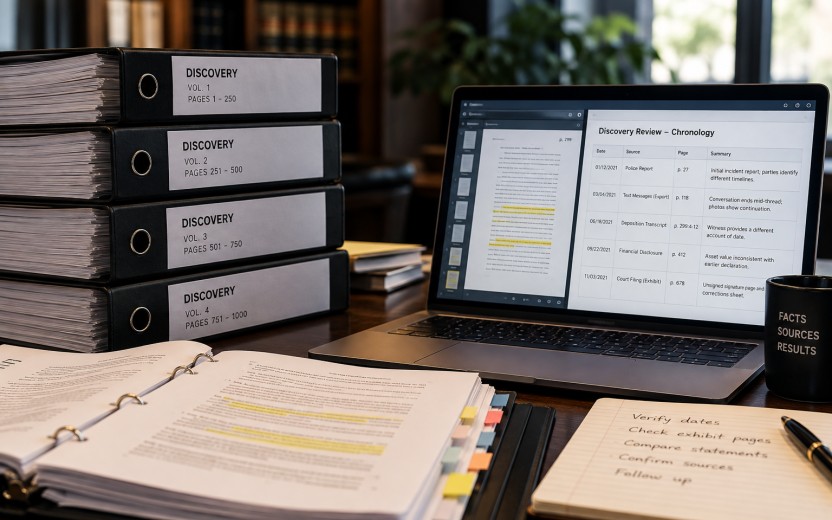
The production arrives on a Friday. Police reports, a recorded interview, phone screenshots, three years of financial disclosures from a related family case, and a deposition transcript lodged as an exhibit to a motion. The file runs to two thousand pages. The next appearance is in two weeks.
Somebody will read it. The question is whether anybody will read all of it.
That distinction decides more cases than the evidence itself. The detail that matters in discovery is almost never concealed. It is filed, produced, and indexed along with everything else. It is simply buried. It could be on the last page of a long filing, in a scan with no searchable text, or in the eight messages a text export stopped short of.
Discovery Review Is a Reading Problem, Not a Search Problem
Most discovery review begins with search. An attorney or paralegal opens the production, runs the names and dates that matter, and reads what comes back. For many matters that is a reasonable place to start. It is a poor place to stop.
Search finds what you already know to look for. It cannot surface the fact that contradicts your understanding of the case, because you did not know to search for it. It also cannot see what the text layer does not contain. A typed filing with scanned exhibits attached often carries no searchable text on the exhibit pages at all. To a keyword search, those pages are blank.
A complete discovery review starts from the other end. Read every page, record what each page says, and only then ask what it means.
What a Full Read Is Designed to Catch
The value of reading everything is not abstract. There are specific kinds of detail that a skim, a keyword pass, or a summary prepared by someone else will reliably miss:
- Records that stop before the events do. A text-message export that ends mid-conversation, while photographs of the same phone screen show the exchange continuing.
- The back of the document. Corrections sheets, unsigned signature pages, and reporter's certificates, which sit at the end of long transcripts and filings that nobody reads to the end.
- Dates and ages that move. An account that places an event in one year to a police officer and a different year in a sworn declaration. When a defendant's age at the time is an element, that movement matters.
- Versions. Two declarations from the same witness, months apart, that differ in a single clause, or two copies of the same filing that differ only by a court's receipt stamp.
- Image-only pages. Exhibits, handwritten notes, and scanned records that exist only as pictures and never appear in a text search.
None of these requires a forensic laboratory. Each requires someone to have read the page.
Why "Cited to the Page" Is the Standard
A finding that cannot be traced to its source is an opinion. In litigation, an untraceable finding is worse than none. It invites opposing counsel to question everything else in the work.
For that reason, discovery review at Atlantis produces a record in which every fact carries a citation: the document, the page, and for transcripts, the page and line. A reader can follow any statement in the report back to the page it came from in seconds. When the evidence conflicts, both versions are reported with their sources, and neither is quietly adopted.
The same discipline governs the originals. Each file is digitally fingerprinted when it is received and preserved unaltered. The working copies are verified against those fingerprints. The file counsel works from is provably the file that was produced.
AI Changed the Speed, Not the Standard
Everybody is talking about AI in legal work, and much of the concern is warranted. Software that summarizes a production without reading it closely, or that states a fact it cannot source, is a liability for any attorney who relies on it.
Atlantis uses proprietary investigative systems, developed in-house, which is how a two-thousand-page production can be read in full in a fraction of the hours a manual review requires. But speed was never the problem worth solving. Accuracy was.
The reading itself is independently verified: a separate pass re-checks the extracted facts against the original page images. The verification is tested with deliberately seeded errors, so its reliability is measured, not assumed. Errors found are corrected before any analysis is written. Then a California-licensed investigator reviews and signs the work.
Everybody is talking about AI. This is more than AI. It is checked, it is cited, and it is signed.
What an Investigator Adds That a Review Platform Does Not
Document review software organizes a production. A licensed investigator does three things that software cannot.
First, the investigator knows what should be there and is not. A police report that references recorded interviews, body-worn video, or uploaded screenshots that were not produced is a discovery request waiting to be written. A report that references another agency's call record points to a subpoena. Our reports identify those gaps and note which items require a subpoena or court order.
Second, the investigator measures the evidence against the standard it will face. In criminal matters, findings are organized against the elements and instructions in the California Criminal Jury Instructions (CALCRIM). Each finding is rated from weak to strong on a stated scale, with its supporting and contrary sources cited. The rating measures how well the documents establish a proposition. It is not a judgment of anyone's truthfulness.
Third, the investigator stays in the investigator's lane. We do not decide what the evidence means for your case. We build the file. You make the call.
Confidentiality Is Part of the Method
Discovery frequently contains the most sensitive material a firm will ever handle: criminal histories, custody evaluations, medical and financial records. Atlantis receives productions through a dedicated, access-controlled intake. Each matter is held in its own restricted workspace, backups are encrypted, and client material is destroyed at the close of the engagement, with a certificate recording what was destroyed.
Some of our analysis uses commercial AI services that do not train on client data. We describe exactly how a production will be processed before it is sent, because counsel is entitled to know.
When to Engage a Discovery Review
A full discovery review is most valuable when the production is too large to read before the decisions it should inform. It is especially valuable when:
- the case turns on dates, ages, or sequence;
- witnesses have given more than one account, across police reports, declarations, depositions, or evaluations;
- the record spans more than one proceeding, such as a criminal case that grew out of a family law file;
- the production includes scans, photographs, or recordings that search cannot reach;
- the next appearance is close enough that the reading has to be done this week, not this month.
The core engagement covers productions of up to 100 files and 2,000 pages at a flat fee, returned by the end of the next business day when received by noon. Findings assessments, statement comparisons, and a full Report of Investigation are quoted before work begins. See Discovery Review for the details. For field work beyond the documents, see Litigation Support and Due Diligence and Pre-Litigation Analysis.
Read It All Before You Decide Anything
The detail that changes a case is usually already in the file. The question is whether anybody reads far enough to find it.
If a production is sitting on your desk, contact Atlantis for a confidential case assessment and secure transfer instructions.